2026-06-11
英語プレゼン質疑応答フレーズ完全版|想定外の質問を切り抜ける返答術25選
英語のプレゼンテーションで、最も多くの人が恐れているのは「本番のQ&A」です。
スライドは完璧に作った。発表の練習も重ねた。でも、質疑応答の時間が始まった瞬間、想定外の質問が飛んできて頭が真っ白になった——そんな経験はありませんか。
実はプレゼンの発表部分よりも、Q&Aの方が「英語の返答力」を問われます。原稿が使えない。どんな質問が来るかわからない。その場で英語を組み立てて答える必要がある。まさにリアルタイムの返答力が試される場面です。
この記事では、英語プレゼンのQ&Aで使えるフレーズ25選を場面別に解説し、想定外の質問を品よく切り抜ける方法をお伝えします。
この記事でわかること
- 英語プレゼンQ&Aで使えるフレーズ25選(場面別)
- 「答えられない質問」「理解できなかった質問」への対処法
- 時間を稼ぎながら印象を上げる返答テクニック
- Q&Aを乗り切るための事前準備の方法
- よくある失敗とNG例・OK例の使い分け
Q&Aで英語が詰まる3つの理由
理由1: 原稿のない即興会話だから
プレゼン本体は準備できますが、Q&Aは来る質問を全て予測できません。準備していない英語を組み立てる必要があり、心理的プレッシャーが高くなります。
理由2: 「答えられない」ことへの恐怖
「わかりません」と英語で言うのは失礼だと感じている人が多いですが、実際はプロとして正直に保留する方が信頼されます。問題は「わかりません」で終わることで、次のアクションまでセットで言えば問題ありません。
理由3: Q&Aの型を知らない
ネイティブスピーカーも「質問を受ける→リピートする→答える→確認する」という型に沿って答えています。この型を知っていると、英語力が同じでも格段に流暢に聞こえます。
英語プレゼンQ&Aフレーズ25選
パート1: 質問を受け取る(質問者への反応)
質問が終わった直後の最初の一言で、聴衆への印象が決まります。
① Thank you for that question.
- 場面: どんな質問にも使える汎用の感謝表現
- 例文: “Thank you for that question. It’s actually something I want to address.”
② That’s a really important question.
- 場面: 発表の核心に関わる質問を受けたとき
- 例文: “That’s a really important question, and I’m glad you brought it up.”
③ That’s an excellent point.
- 場面: 鋭い指摘や、発表で触れられなかった角度からの質問
- 例文: “That’s an excellent point. I should have addressed that in my presentation.”
④ I appreciate you raising that.
- 場面: やや難しい・デリケートな質問を受けたとき
- 例文: “I appreciate you raising that. It’s something we’ve been looking into internally.”
⑤ That’s a question I’ve been expecting.
- 場面: 事前に予測していた質問が来たとき。準備していることを示せる
- 例文: “That’s a question I’ve been expecting. Let me explain our approach.”
パート2: 質問を確認・リピートする
質問をリピートすることで3つの効果があります:①聞き取れなかった質問の確認、②考える時間を稼ぐ、③他の参加者にも質問内容を共有する。
⑥ If I understand your question correctly…
- 場面: 理解が正しいかを確認しながらリピートする
- 例文: “If I understand your question correctly, you’re asking whether this approach scales beyond Q3?”
⑦ So what you’re asking is…
- 場面: ⑥よりカジュアル。社内会議での発表に適している
- 例文: “So what you’re asking is how we plan to address the cost overrun in phase two?”
⑧ Just to make sure I’m answering the right question…
- 場面: 質問が複数の解釈を持つとき
- 例文: “Just to make sure I’m answering the right question—are you asking about the technical approach or the timeline?”
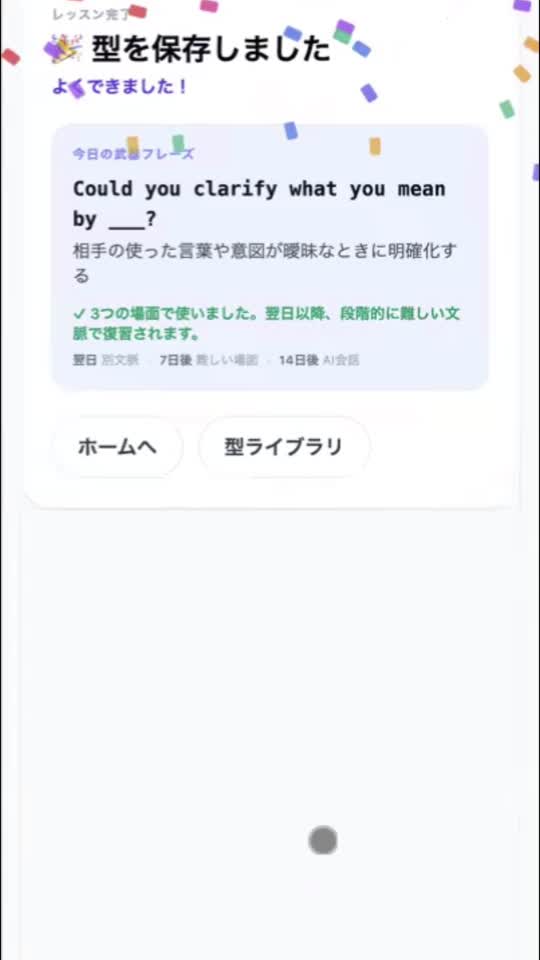
⑨ Could you clarify what you mean by [キーワード]?
- 場面: 質問の用語や範囲が不明確なとき
- 例文: “Could you clarify what you mean by ‘scalability’ in this context?”
⑩ Could you repeat the question? I want to make sure I address it properly.
- 場面: 聞き取れなかったとき。「もう一度お願いします」をプロフェッショナルに言う
- 例文: “I’m sorry, could you repeat the question? There was some background noise and I want to make sure I address it properly.”
パート3: 時間を稼ぎながら答え始める
⑪ Let me think about the best way to answer that.
- 場面: 少し複雑な質問で、言葉を選びながら答えるとき
- 例文: “Let me think about the best way to answer that… There are a few aspects to consider.”
⑫ That’s a multifaceted question. Let me break it down.
- 場面: 質問に複数の論点があるとき
- 例文: “That’s a multifaceted question. Let me break it down into two parts.”
⑬ There are a few ways to look at this.
- 場面: 複数の視点から答えたいとき
- 例文: “There are a few ways to look at this. From a technical perspective… and from a business perspective…”
⑭ This actually ties back to what I mentioned in slide three.
- 場面: 発表内容と質問を結びつけながら答えるとき
- 例文: “This actually ties back to what I mentioned in slide three, where we talked about…”
⑮ The short answer is [短い答え], but let me give you a bit more context.
- 場面: まず結論を言ってから、詳細を説明する構造で答えるとき
- 例文: “The short answer is yes, but let me give you a bit more context on why we chose this approach.”
パート4: 答えられない・データがない場合
⑯ I don’t have that data with me right now, but I can follow up.
- 場面: 具体的な数字やデータを求められたが手元にないとき
- 例文: “I don’t have that data with me right now, but I can follow up with you after this session.”
⑰ That’s outside the scope of what I covered today, but it’s a great question.
- 場面: 発表の範囲外の質問を受けたとき
- 例文: “That’s outside the scope of what I covered today, but it’s a great question. I’d be happy to discuss it offline.”
⑱ I’m not the right person to answer that with authority.
- 場面: 専門外の質問を受けたとき
- 例文: “I’m not the right person to answer that with authority. I can connect you with our technical lead.”
⑲ I’d rather give you an accurate answer than guess.
- 場面: 推測では答えたくないことを正直に伝えるとき
- 例文: “I’d rather give you an accurate answer than guess. Can I get back to you on that by tomorrow?”
⑳ That’s a hypothesis I haven’t fully tested yet.
- 場面: まだ検証中の事項について聞かれたとき
- 例文: “That’s a hypothesis I haven’t fully tested yet. I’ll be able to give you a more definitive answer after our pilot.”
パート5: 答えた後の確認・クロージング
㉑ Does that answer your question?
- 場面: 自分の答えが質問に対応していたかを確認
- 例文: “Does that answer your question, or would you like me to go deeper on any aspect?”
㉒ I hope that addresses what you were asking.
- 場面: ⑳よりも少し丁寧なバージョン
- 例文: “I hope that addresses what you were asking. If not, I’m happy to elaborate.”
㉓ If you have any follow-up questions, please feel free to reach out.
- 場面: Q&Aセッション全体の締め
- 例文: “If you have any follow-up questions after today, please feel free to reach out to me directly.”
㉔ I’d love to continue this conversation offline.
- 場面: 深い議論が必要だが時間が限られているとき
- 例文: “I’d love to continue this conversation offline. The topic deserves more time than we have here.”
㉕ We can revisit this if there’s time at the end.
- 場面: まず他の質問に対応してから戻りたいとき
- 例文: “Can I come back to that question? We can revisit this if there’s time at the end.”
Q&Aで使える「つなぎ言葉」
以下のつなぎ言葉を使うと、フレーズ間がスムーズに聞こえます:
| 意図 | 表現 |
|---|---|
| 逆接 | However, / That said, / On the other hand, |
| 付け加える | Additionally, / Furthermore, / On top of that, |
| 例を示す | For example, / For instance, / To give you a concrete example, |
| 結論 | In conclusion, / To summarize, / So in short, |
| 確認 | Does that make sense? / Is that clear? |
よくある失敗とNG例
失敗1: 質問されたらすぐ話し出す
答えが準備できていないのに話し出すと、途中で詰まります。まず①〜⑤の「受け取り表現」を言ってから始めましょう。
失敗2: 「I don’t know」で終わる
- △: “I don’t know.”
- ○: “I don’t have that data right now, but I can follow up with you by tomorrow.”
失敗3: 嘘をつく
正確でない情報を確信を持って言うことは、後でバレたときに信頼を大きく損ないます。わからないことは⑯〜⑲で正直に伝えましょう。
失敗4: 「That’s a great question」を全ての質問に言う
すべての質問に「That’s a great question!」と言うと、嘘っぽく聞こえます。本当に良いと思った質問にだけ使いましょう。
Q&Aのための事前準備
Q&Aを乗り切るには、当日の対応力だけでなく事前準備が重要です。
予想質問リストを作る
発表内容を見直し、「聴衆が気になりそうな点」を10個書き出します。特に:
- 数字や根拠が弱そうな部分
- 発表で時間の都合上省略した箇所
- 競合やリスクについて
答えられない場合の言い方を練習する
「わかりません」と言う練習を意図的にしておきましょう。自然に「I don’t have that data right now, but I can follow up.」と言えるようにしておくだけで、当日の心理的余裕が全く違います。
Reply English では、英語プレゼン後のQ&Aシナリオを繰り返し練習できます。AIが予想外の質問を投げかけてくるシナリオを通じて、「考える間を作る→答える→確認する」の一連の流れを身体に染み込ませられます。
まとめ
英語プレゼンのQ&Aで差をつけるポイントをまとめます:
- 受け取り→確認→答える→確認 の型を使う
- 答えられない質問は正直に保留する(嘘より誠実さが信頼を生む)
- 時間稼ぎフレーズをセットで持つ(そうすれば焦りが消える)
- 事前に予想質問を10個作っておく
「英語のプレゼンができる」だけでは不十分な時代です。Q&Aで真の返答力を示せる人が評価されます。
よくある質問(FAQ)
Q1. 質問の英語が速くて聞き取れないときはどうすればいいですか? A. “Could you repeat that more slowly?” より “I want to make sure I understand your question correctly. Could you say that again?”の方が丁寧に聞こえます。
Q2. 複数の質問を一度に受けた場合はどうすればいいですか? A. “I want to address both points. Let me start with the first one, which is…” と言って順番に答えましょう。
Q3. 答えた後に「それは回答になっていない」と言われたら? A. “You’re right. Let me try to be more direct.” と認めてから、もう一度答え直しましょう。否定されることを恐れず、正直な対応が信頼につながります。
Q4. オンライン会議(Zoom)でのQ&Aで特に注意することは? A. チャットで飛んでくる質問も拾うことを忘れずに。「I see a question in the chat. [質問を読み上げる]…」と言ってから答えると丁寧です。
Q5. 時間制限があるQ&Aで質問が多すぎたらどうすればいいですか? A. “We’re running short on time, but I’d love to answer remaining questions offline. Please feel free to email me.”
Q6. 「なぜそのアプローチを選んだのか」という挑戦的な質問を受けたら? A. “That’s a fair challenge. Our rationale was [理由]. We acknowledge that [alternative] was also considered, but we chose this because [根拠].” というフォームで答えると論理的に聞こえます。
※ AI 下書き。公開前に必ず人間レビュー・修正を行ってください。
返答力を鍛えてみませんか?
Reply English は、英語会議のビジネスシナリオで「返す」練習に特化した AI 練習アプリです。7日間無料で体験できます。
今週の会議英語を練習する →7日間無料 · カード不要 · ダウンロード不要